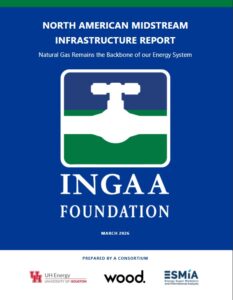
WASHINGTON, D.C., March 13, 2026 – Today, the INGAA Foundation released its 2025 North American Midstream Infrastructure Report outlining the scale of infrastructure investment required to meet projected energy demand across the United States and Canada through 2052.
The report assesses future energy needs and the pipelines and related midstream infrastructure required to support expected energy demand. The analysis, conducted by experts from the University of Houston (UH), Wood, and ESMIA Consultants, models outcomes under two scenarios: a Reference Case reflecting current federal, state, and provincial policies as of April 1, 2025, and a Low Carbon Scenario which assumes more aggressive GHG reduction efforts in North America and globally.
The report finds that natural gas remains a foundational component of the North American energy system under both scenarios. Rising electricity demand, particularly from data centers, along with continued growth in liquefied natural gas (LNG) exports, drives the need for significant infrastructure expansion.
To meet projected demand through 2052, the study concludes that North America will require:
- More than $1 trillion in new midstream capital investment, averaging $40–$48 billion per year across natural gas, oil, natural gas liquids, hydrogen, and CO₂ infrastructure.
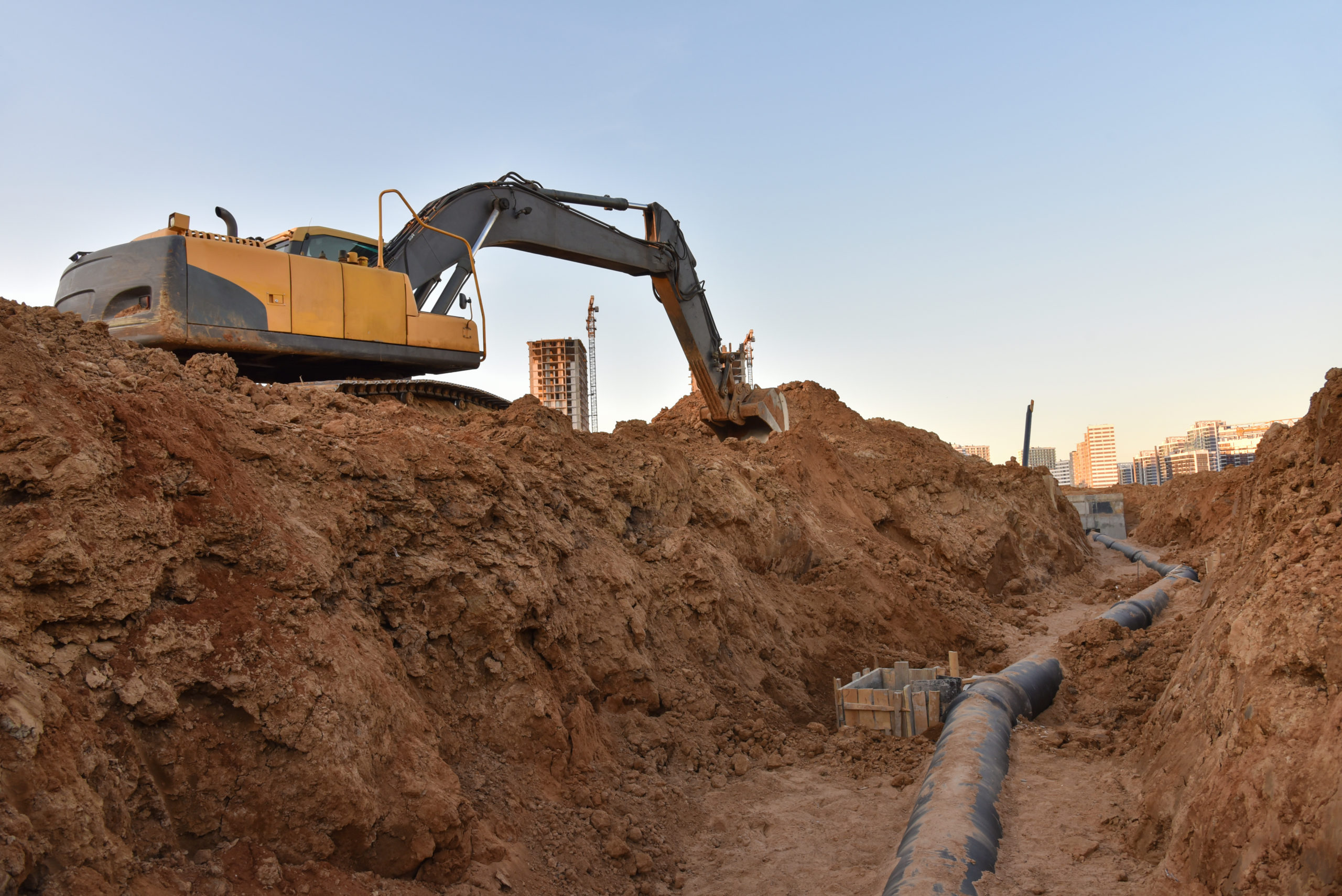
- At least 37,000 miles of additional natural gas transmission pipelines, including approximately 33,800 miles within the United States, to move energy from producing regions to growing areas of demand.
- Approximately 103,000 miles of new natural gas gathering pipelines to connect upstream production to processing facilities and long-haul transmission systems.
- An estimated 12-24 million cumulative jobs over 25 years (including 2-4 million direct, 4-8 million indirect, and 6-12 million induced jobs), or roughly 414,000-828,000 jobs annually throughout the study period, varying with investment.
“Meeting energy demand is a critical challenge right now, and this report, by the experts at the University of Houston, Wood, and ESMIA, quantifies the necessary midstream infrastructure and corresponding development dollars needed to meet that demand,” said Hebe Shaw, Executive Director of the INGAA Foundation. “Meeting the energy needs of North America will require sustained investment and development, which must begin now to ensure a safe, reliable, and affordable energy system.”
The UH team was led by the Division of Energy and Innovation, with support from faculty and staff at the C.T. Bauer College of Business.
Wood, a global leader in consulting, engineering, and operations for the energy and materials sectors, provided key project management leadership as well as domain expertise for the midstream sector.
ESMIA, which is based in Canada, contributed a detailed economy-wide energy system model, the North American TIMES Energy Model (NATEM), which was used to model components of the North American energy system to 2052 with an emphasis on midstream infrastructure of the natural gas sector. The ESMIA team also provided expertise in the analysis and interpretation of the model results.
“The University of Houston was pleased to lead the consortium that conducted this analysis,” said Paul Doucette, Principal Investigator of the report. “The consortium worked closely with a team of industry experts as well as university faculty and staff to evaluate the market forces shaping North America’s energy future. The final report draws on decades of experience and equips industry leaders and policymakers with the clarity and confidence needed to plan, permit, and build the infrastructure required to power a growing economy through 2052.”
“We were proud to bring our deep technical and commercial midstream expertise to the modeling process for this study,” said Nishadi Davis, Director of Strategic Advisory for the Americas at Wood. “Long-range forecasts are only as strong as the assumptions that underpin them, and this study ensures that infrastructure projections are grounded in real-world engineering, cost, and operational considerations. By anchoring the modeling in our infrastructure experience across natural gas, liquids, hydrogen, and CO₂ systems, we have ensured that this study accurately reflects what can realistically be built, financed, and operated.”
“Using our integrated energy system modeling approach for the INGAA Foundation’s North American Midstream Infrastructure Report, we worked with the consortium to apply the NATEM framework to assess long-term natural gas demand and infrastructure needs,” said Anna Cybulsky, Head of Energy System Integration at ESMIA. “Our team translated complex modeling results into clear insights on infrastructure requirements, market dynamics, and policy interactions to provide a transparent, data-driven foundation to help industry and policymakers plan for the future with confidence.”
###
Formed in 1990 by the Interstate Natural Gas Association of America, the INGAA Foundation facilitates the safe, affordable, reliable, clean energy solutions for the people of North America and the world. The INGAA Foundation is regarded as the premier organization to convene industry leaders from natural gas and complementary clean energy solutions to identify and address critical matters related to the development, construction, operation, and maintenance of the gas infrastructure value chain through research, engagement, and outreach.