
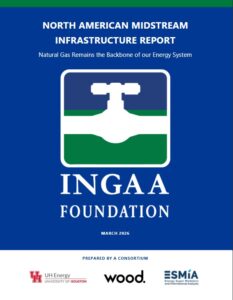
Last week, The INGAA Foundation released its 2025 North American Midstream Infrastructure Report, examining the infrastructure needed to meet projected energy demand in the United States and Canada through 2052. The analysis finds that more than $1 trillion in new midstream investment will be needed to support rising electricity demand, growing LNG exports, and continued development of North America’s energy resources, including at least 37,000 miles of new natural gas transmission pipelines and 103,000 miles of gathering lines.
Coverage highlights the scale of infrastructure needed and the key demand drivers behind it:
• Forbes: Study Finds Additional $1 Trillion in Pipeline Capital Needs by 2052. “The Study… reveals the need for an eyewatering $1 trillion in capital for new pipeline infrastructure in the United States and Canada alone by 2052, an average of roughly $40-48 billion per year across the next 26 years. Hebe Shaw, Executive Director of the INGAA Foundation, got it right when she stated in the study’s release: “Meeting the energy needs of North America will require sustained investment and development, which must begin now to ensure a safe, reliable, and affordable energy system.” (March 16, 2026)
• S&P Global: LNG is largest driver for pipeline expansions needed by 2052. “North America will need to add 70 billion cubic feet/day of new gas pipeline capacity by 2052 to meet the energy needs expected from gas-fired power generation and LNG exports.” (March 16, 2026)
• Politico: The Pipeline for Pipelines: “The U.S. and Canada will need at least 37,000 miles of new natural gas transmission pipelines and 103,000 miles of gathering lines by 2052 to keep up with rising gas demand in a business-as-usual case, according to a new report commissioned by the Interstate Natural Gas Association of America Foundation. That would be an increase of nearly 40 percent in capacity to transport an additional 70 billion cubic feet of gas per day, the researchers from University of Houston, Wood and ESMIA Consultants found. Even a “low-carbon scenario,” which assumes state and international climate targets are met, would require more than 25,000 miles of new natural gas pipelines.” (March 16, 2026)
• Pipeline & Gas Journal: Study Signals $1 Trillion Pipeline Buildout Needed Across U.S., Canada by 2052. “Beyond infrastructure, the study also projects substantial economic impact, with millions of jobs tied to pipeline construction and related activity over the coming decades. Despite the positive outlook at the time, permitting challenges and legal risks remained key hurdles, particularly in regions with strong environmental opposition. Even then, LNG export growth was viewed as the primary driver behind continued pipeline development.” (March 17, 2026)
• Natural Gas Intel: Natural Gas Pipeline Capacity Must Grow 39% as LNG, Data Center Demand Surge, INGAA Says. “A 189-page report that found a massive buildout need for natural gas pipelines under both business as usual and low carbon scenarios, echoing warnings from midstream companies in recent years about tightening pipeline and storage capacity.” (March 17, 2026)
The takeaway from recent headlines is clear: Meeting North America’s growing demand will require a significant expansion of natural gas pipeline infrastructure. Without strategic investment in this infrastructure, demand will outpace capacity, putting reliable energy at risk. Timely construction will ensure energy needs are met while supporting economic growth and creating jobs.
Read the report here.