

The National Petroleum Council’s new reports arrive at an important moment for America’s energy future. As demand for natural gas and electricity rises, the country faces a familiar challenge: our infrastructure can’t keep up.
For years, INGAA and our members have highlighted this reality and advocated for the commonsense reforms needed to address it. The NPC’s latest work reinforces those points and elevates them to the national stage at a time when policymakers are focused on real, actionable solutions. Importantly, the reports outline a path forward: America has the natural gas to power the nation for generations, but we need modern permitting processes and strengthened coordination with the electric sector to continue to deliver the affordable, reliable energy Americans deserve.
The data tells a clear story. From 2010 to 2022, nationwide natural gas consumption grew 56%, driven largely by rising electricity demand, while pipeline capacity increased only 27% and storage capacity just 12%. As the figure below shows, U.S. storage deliverability has remained largely unchanged since 2014 even as natural gas demand climbed nearly 50% between 2013 and 2024.
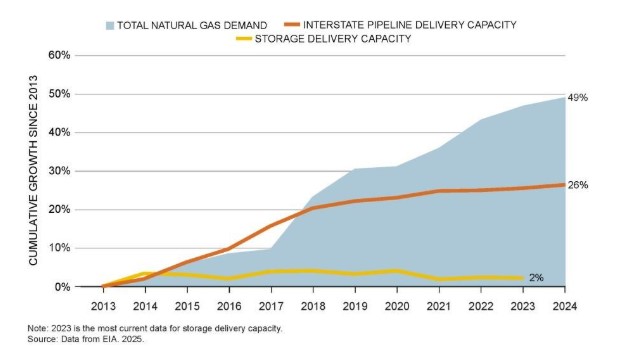
Source: National Petroleum Council
Natural gas now supports the largest share of U.S. electricity generation, yet the commercial and operational structures governing pipelines and power markets remain out of sync. Pipelines built to serve steady, predictable loads are increasingly expected to support an electric system that depends on rapid, flexible generation. Winter Storm Elliott made this mismatch clear, as generators struggled to secure fuel and pipeline pressures fell to dangerous levels.
The permitting system is a key part of the problem. Lengthy reviews, unpredictable timelines, and overlapping requirements make it harder to build infrastructure needed to close the gap.
The reports From Bottleneck to Breakthrough: A Blueprint for Permitting Reform and Reliable Energy: Delivering on the Promise of Gas-Electric Coordination each include a set of 10 recommendations that facilitate investment in energy infrastructure to ensure we can keep up with growing demand affordably and reliably. Many of these recommendations reflect issues INGAA has long prioritized in its federal advocacy, and we welcome the Administration’s efforts to elevate them to the national policy conversation.
From Bottleneck to Breakthrough lays out permitting reforms that, if enacted into law, will accelerate energy infrastructure deployment and reduce project delays. The report includes recommendations intended to clarify and modernize review standards under the National Environmental Policy Act (NEPA) to reduce redundancy, expedite environmental litigation timelines, and remove procedural uncertainty that can delay projects for years. The report also recommends limiting the scope for duplicative state actions under Clean Water Act Section 401 that can stall federal project approvals, and establishing predictable federal timeline requirements for every major step of a permitting review.
Reliable Energy highlights the increasing reliance on natural gas for electricity and the need to expand the national pipeline network to ensure continued energy affordability and reliability. The report includes recommendations that prioritize infrastructure investment by focusing on building fit-for-purpose natural gas pipelines and related infrastructure to meet peak and variable electricity demand. Additionally, the report encourages joint long-term planning by FERC, RTOs, ISOs, and gas pipelines, and developing pricing and capacity mechanisms that reflect the true cost and reliability contributions of gas infrastructure.
The path ahead is clear: policymakers should move quickly to adopt the practical reforms outlined in the NPC’s work. By embracing these bold yet commonsense recommendations, the United States can meet rising demand and strengthen the foundation of long-term energy security.